
The Waterfall That Moves
The Falls are moving upstream
It may look permanent, but Niagara Falls is slowly moving.
When the last Ice Age ended, about 12,000 years ago, the waterfall wasn't here. It began much farther downstream, near today's Queenston and Lewiston — about 11 kilometres away. Everything between that point and where you are standing now was carved out by the Falls itself.
So how does a waterfall move?
Water pours over the edge every second of every day. What most people don't see is what happens underneath. The top layer of rock is hard and strong. Beneath it is a softer layer. As the water crashes down, it eats away at the softer rock first, carving a hollow space behind the edge.
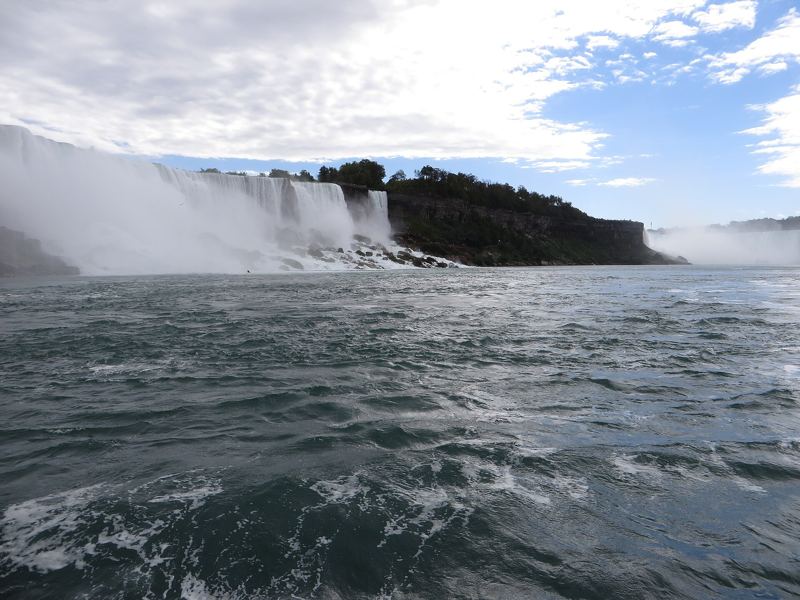
Eventually the hard rock above has nothing holding it up — and it collapses. When that happens, the edge of the Falls shifts slightly upstream, and the process starts again.
In the 1800s, before modern water control, the Falls were moving back at an average of about one metre per year — roughly one big step. At that speed, people could measure the change within a lifetime.
Today, much of the river's water is diverted for hydroelectric power before it reaches the edge. With less water crashing down, erosion has slowed dramatically. The Falls now retreat only a fraction as fast — about 30 centimetres per year or less.
That means Niagara is still moving — just more slowly than before.
The gorge downstream is the proof. Every cliff and every curve in its rock walls marks a place where the Falls once stood. It isn't just a scenic canyon — it's a timeline carved in stone.
This sign stands at Queen Victoria Park. See it on the map
Next sign 9Three Falls, One River Queen Victoria Park, facing the American FallsPhoto credits
- Ken Lund, CC BY-SA 2.0, via Wikimedia Commons
